
· by Michael Blair, Nashville's Weed and Feed
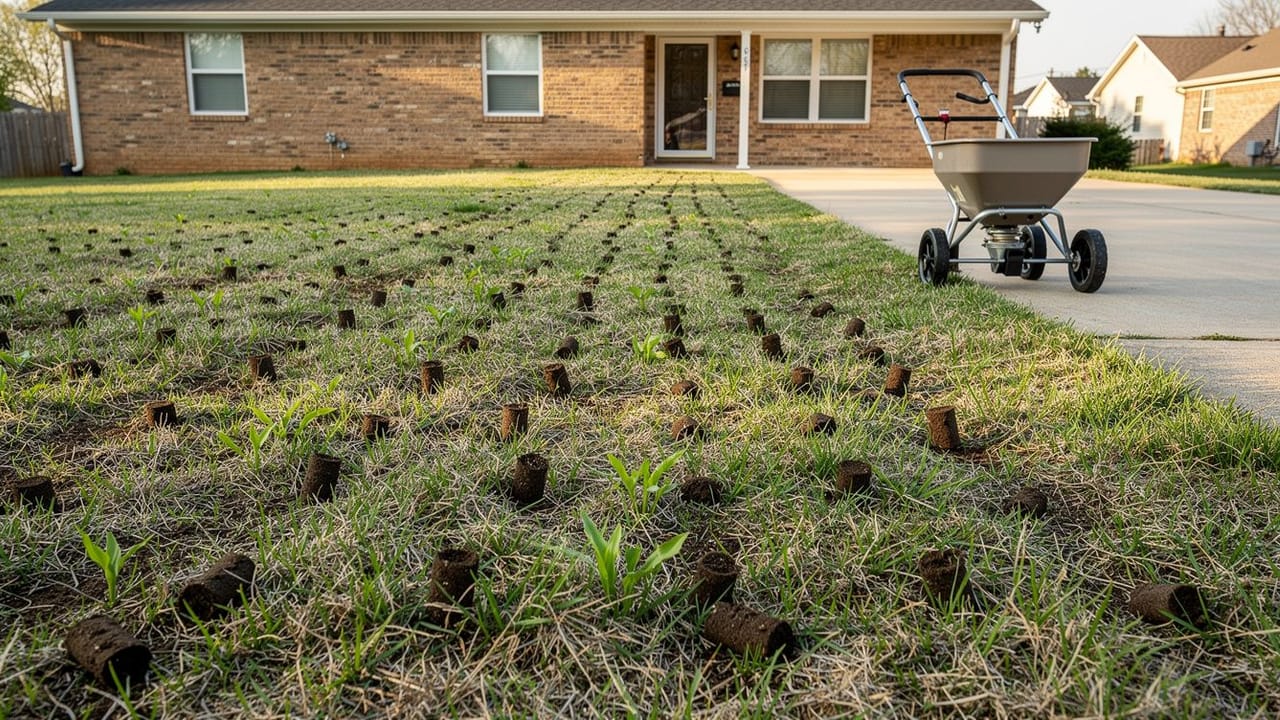
By March a fescue lawn that thinned out over the summer looks its worst, and the bare patches seem to be asking for seed. Spring is also when the crabgrass preventer goes down. Those two jobs work against each other, and in Middle Tennessee the calendar works against spring seed as well. This post covers what UT Extension says about seeding cool-season grass in spring, why most pre-emergents and new seed cannot share the same ground, and how we handle a thin lawn on our aeration and overseeding visits.
Will spring-seeded fescue make it through a Nashville summer?
Often it will not. The UT Master Gardener chapter on turfgrass management in Tennessee says cool-season grass planted in late winter or early spring often comes up as poorly developed seedlings that may not be able to survive hot, dry summer weather. Its recommendation for tall fescue and Kentucky bluegrass is to seed from late August to mid-October.
The reason is time. Seed sown in fall has the cool months to build roots before its first summer. Seed sown in April has a few weeks before the heat arrives, and a fescue seedling with short roots in July is competing with crabgrass, heat and dry spells all at once. Nashville sits in the transition zone, where tall fescue grows but summer is the hard part of its year.
Spring seed is not hopeless. A small patch that can be watered faithfully has a better chance than a whole yard. But for a lawn that is thin all over, the seed bought in March is very often the seed bought again in September.
Why do crabgrass preventer and grass seed work against each other?
Most pre-emergent herbicides stop seeds from rooting, and they do not tell a crabgrass seed from a fescue seed. UT Extension’s guide to lawn and landscape weed control for homeowners says most pre-emergents interfere with establishment and root growth of grass that was just planted or is about to be, and it tells homeowners to follow the label’s timing before and after planting, particularly when overseeding.
The same guide shows why the timing is hard to fit around. It says pre-emergents generally control weeds for 12 to 16 weeks, and that the first spring application goes down once the soil in the top 2 inches has averaged 55 degrees over 24 hours for several days in a row, with a split application about eight weeks later. Both have to be watered in within 24 to 48 hours. A lawn on that program has an active barrier in the soil from early spring well into summer, which is the whole window for spring seeding.
So a spring lawn usually gets one or the other. Our post on pre-emergent timing in Nashville covers when the barrier goes down; this post is about what it means for seed.
How long does a pre-emergent hold up new seed?
It can be weeks to months, depending on the product. A 2005 study by Keeley and Zhou in the journal Weed Technology applied three common pre-emergents in late April and seeded at intervals afterward. With seed broadcast on the surface, acceptable seedling growth needed a wait of about 6 weeks after dithiopyr, 8 after pendimethalin and 14 after prodiamine. Slit seeding needed roughly 11, 10 and 16 weeks.
Those numbers come with a caveat. The grass seeded in that study was Kentucky bluegrass, not tall fescue. It shows how long these products can linger and how much they differ, not a schedule for a fescue lawn here. On any lawn, the product’s own label sets the wait.
A 2015 Kansas Agricultural Experiment Station report by Hoyle and Reeves tested prodiamine and dithiopyr with spring-seeded tall fescue at a site in Kansas and one in Nebraska. Where crabgrass pressure was low, the pre-emergents held the seeding back; where pressure was heavy, the crabgrass control came out as a benefit to the seeding. Those are two sites in Kansas and Nebraska, not Middle Tennessee, but it matches the trade-off: in spring you choose which problem to accept.
How we handle a thin lawn in spring
For most thin fescue lawns, we put down the spring pre-emergent on schedule, keep the existing grass fed and mowed high through summer, and core aerate and overseed in fall, when UT says seed does best. Fall seeding brings its own weed timing, which our post on fall weed control around a new overseed covers.
Where a patch is bare enough that it cannot wait, we leave the pre-emergent off that patch, seed it, and keep it watered, accepting that crabgrass may come in there. If crabgrass shows up in a young stand anyway, our post on crabgrass in a fescue lawn explains why the grass’s size decides what can be used on it.
In Franklin, Nashville and the towns around them, tell us how thin the lawn is and where. We will walk it, tell you whether this spring is a pre-emergent year or a patch-seeding year, and set the overseeding for fall.
Sources
- UT Extension Master Gardener, Chapter 10: Turfgrass Management in Tennessee — Late August to mid-October an excellent time to seed Kentucky bluegrass and fescues; late winter or early spring seeding often yields poorly developed seedlings that may not survive hot, dry summer weather
- UT Extension W 1068, Lawn and Landscape Weed Control for Homeowners (Breeden, Brosnan, Samples, Bumgarner) — Most pre-emergents interfere with establishment of newly planted grass; follow label timing when overseeding; 12 to 16 weeks of control; first spring application at a 55 F 24-hour soil average in the top 2 inches; split application eight weeks later; watered in within 24 to 48 hours
- Keeley and Zhou (2005), Preemergence herbicide and seeding method effects on seedling growth of Kentucky bluegrass, Weed Technology 19(1):43-46 — Kentucky bluegrass seeded after late-April applications: about 6 weeks (dithiopyr), 8 (pendimethalin) and 14 (prodiamine) for broadcast seeding; about 11, 10 and 16 for slit seeding
- Hoyle and Reeves (2015), Crabgrass Control in Spring Seeding Using Early and Late Combinations of Prodiamine and Dithiopyr, Kansas Agricultural Experiment Station Research Reports 1(6) — Spring tall fescue seeding: pre-emergents held seeding back at a low-pressure Kansas site and helped at a high-pressure Nebraska site
FAQ
Spring Overseeding in Nashville and Pre-Emergent — questions
Can you overseed in the spring?
You can, but in Middle Tennessee it often disappoints. UT Extension says cool-season grass seeded in late winter or early spring tends to produce weak seedlings that may not survive hot, dry summer weather. Spring seeding also usually means skipping the crabgrass pre-emergent on that ground, since most pre-emergents stop new grass from rooting.
Should I overseed in the spring or the fall?
Fall, for tall fescue and Kentucky bluegrass in Tennessee. UT Extension calls late August to mid-October an excellent time to seed them, because the seedlings get cool weather to root before their first summer. Spring is for small bare patches that can be watered faithfully and left without pre-emergent.
Can you put down crabgrass preventer and grass seed at the same time?
With most products, no. Most pre-emergent herbicides interfere with the rooting of newly planted grass as well as weeds, so seed spread over them often fails. UT Extension tells homeowners to follow the label’s timing before and after planting. Check your product’s label for its seeding interval before spreading seed.
Does pre emergent stop grass seed from growing?
Most do. They form a barrier in the top of the soil that stops young roots, and they do not tell a crabgrass seedling from a fescue one. One study found the wait before seeding did well ranged from about 6 to 14 weeks depending on the product, though it seeded Kentucky bluegrass, not fescue.
When should you overseed fescue in Tennessee?
From late August to mid-October, according to UT Extension. Seed sown then has fall and winter to build roots before summer heat, while spring-sown seedlings often cannot survive hot, dry weather. Fall seeding also falls outside the spring pre-emergent window, though fall weed control around new seed needs its own timing.